
Sattva Dabaspete Plot Options
Sattva Ekatra, at Thippapura in Doddaballapura taluk off the Satellite Town Ring Road, is Sattva's most recent plotted layout, registered on 18 September 2026 and presented on Sattva's site as newly launched.
Status: Upcoming - Sattva has not announced this layout; no K-RERA registration is shown as at 4 October 2026.
A plot is the one purchase where you design the product yourself, and the shape of the land decides how the house can be drawn. Sattva Ekatra, a registered Sattva layout at Thippapura, offers compact 20 x 30 plots and 30 x 40 plots, and Sattva Kaveri Siri II at Mandya offers a wider spread, so Sattva's earlier layouts are a useful guide to how plot choice works. This page sets those sizes out by named layout, then walks through how to choose between them. Sattva has not announced plot sizes for Sattva Dabaspete, so the table below describes past projects, not this one. Sattva Ekatra is relevant when the floor-plan decision turns from square footage to storage, work-from-home use, bedroom privacy, and long-term family comfort.
Plot Sizes in Sattva's Earlier Layouts
| Layout | Where | Plot sizes listed | Other plots |
|---|---|---|---|
| Sattva Ekatra | Thippapura, Doddaballapura taluk | 20 x 30 ft (600 sq ft), 30 x 40 ft (1,200 sq ft), 30 x 45 ft, 30 x 50 ft and 30 x 60 ft, as filed with K-RERA | Odd-sized plots also offered |
| Sattva Kaveri Siri II | Mandya | Regular plots from 600 to 2,400 sq ft, according to Sattva's page for the layout; the K-RERA entry lists 20 x 30, 30 x 40 and 30 x 50 ft plots | Odd sizes also offered |
Ekatra's plot list differs between sources: Sattva's own page names 20 x 30, 30 x 40 and 40 x 50 ft formats, while the K-RERA entry lists 20 x 30, 30 x 40, 30 x 45, 30 x 50 and 30 x 60 ft plots and no 40 x 50 ft plot. Ask Sattva for the current plot list with dimensions before you rely on any size from a portal or a brochure.
The Ekatra sizes form a ladder: the 20 x 30 plot is the entry size and the 30 x 40 plot is the family-home format, so the choice between them is a choice between a compact home planned vertically and one with a car porch and some garden. Kaveri Siri II shows the same range logic stretched further, with a 600 sq ft starter plot at one end and, on Sattva's page, a 2,400 sq ft plot at the other.
Sattva's other plotted layouts, Serene Life, Kaveri Siri, Green Groves and Bhumi, each carry their own mix of sizes, and Sattva's page for Green Groves does not list them. If you are comparing any of them, ask Sattva for that layout's current plot list with dimensions.
Choosing a Plot Size
Start with the house, not the plot. Decide how many floors you want to build, how many bedrooms the family needs and whether you want a car porch, and then work backwards to the land.
- Area in sq ft. A 30 x 40 plot and a 20 x 60 plot both measure 1,200 sq ft, yet they build very differently. Area is the number on the price list; frontage and depth decide the floor plan.
- Frontage. A wider frontage gives more room for a car porch, a front garden and street-facing windows. A narrow frontage pushes the house back and tends to produce long, corridor-style rooms.
- Depth. A deeper plot allows a rear courtyard, a utility yard or a future extension. A shallow, wide plot gives bright front rooms but less privacy at the back.
- Buildable area. The land you own is not the land you can cover. Setbacks, ground coverage and floor area ratio come from the layout approval and the local building bye-laws, so ask for the figures that apply to your plot in writing instead of assuming a rule of thumb.
- Future plans. If you may add a floor or a rental unit later, check the permitted height and the staircase position before you buy, because both are cheaper to plan now than to retrofit.
- Budget beyond the plot. Construction, interiors, the electricity connection and compound walls come on top of the plot price. A larger plot with a smaller house can cost more overall than a smaller plot built fully, so test both.
A useful exercise is to sketch your house on graph paper at the dimensions of each size you are considering. A 600 sq ft plot suits a compact home planned vertically; a 1,200 sq ft plot leaves room for a porch and a small garden; larger formats make room for a bigger garden or a second living level with space around it.
Facing, Corner and Odd-shaped Plots
The road a plot opens on shapes its light, privacy and ventilation, so read the orientation off the layout plan, not off the brochure.
- Facing. The side of the plot that meets the road decides which rooms catch morning light and which take the afternoon sun. Look at the layout plan's north arrow, then picture where the living room, kitchen and bedrooms would sit. If a facing preference matters to your family, settle it before you choose a block, because it narrows the available plots quickly.
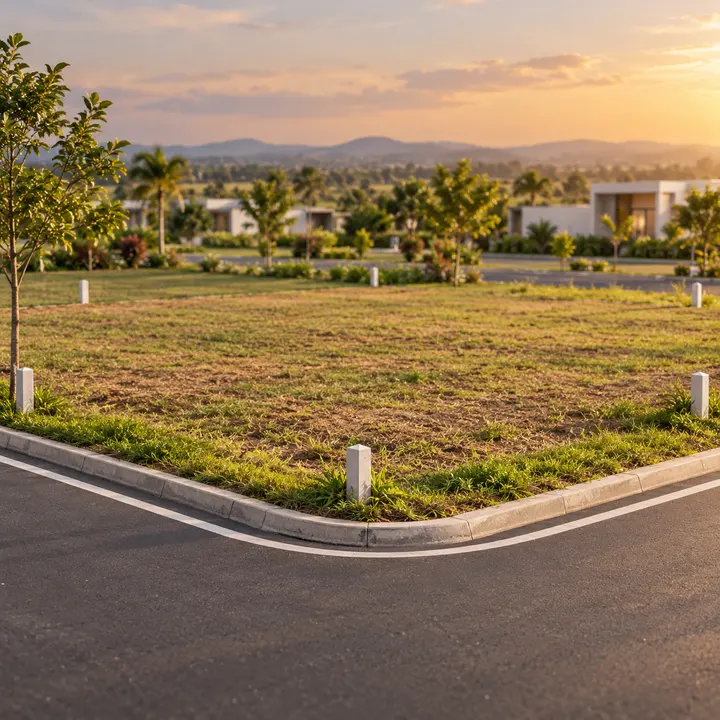
- Corner plots. A corner plot has two road frontages. That brings extra light, easier access and a more open elevation, and it can also bring more setback to leave on the second road, more traffic noise and, in many layouts, a different price. Ask how the corner is priced and how much of the plot is buildable.
- Plots on a wider road. Plots on the main internal road gain visibility and access for larger vehicles, and lose some quiet. Plots on narrower inner roads are calmer. Check the width of the road in front of your plot on the sanctioned plan.
- Odd-shaped plots. Sattva Ekatra and Kaveri Siri II both list odd-sized plots next to their regular formats. With these, the shape counts as much as the area: draw the biggest rectangle that fits inside the plot, since that is the footprint a standard house plan can use. An odd plot can suit a buyer who wants a size between the regular formats, as long as that rectangle works for the house you have in mind.
- Position in the layout. Plots near the clubhouse, entrance or a park gain convenience, plots next to a transformer, a water tank or a sewage plant may not. Walk the site, not just the plan.
Plot Sizes for Sattva Dabaspete
| Item | Status |
|---|---|
| Plot sizes | Not yet announced |
| Plot count | Not yet announced |
| Price per sq ft | Not yet announced |
| K-RERA registration | None shown as at 4 October 2026 |
| Launch date | Not yet announced |
Sattva has not announced plot sizes. The registration cost on any plot is covered in the price guide, the layouts Sattva has completed and registered are on the reviews page, and the contact page is where to register interest so you hear when Sattva announces the layout.
What to ask for
When Sattva does announce the layout, ask for the sanctioned layout plan showing every plot number with its dimensions, the list of plot sizes with their counts, the road width in front of each plot, the corner and odd-shaped plots marked, and the buildable area for your plot. Confirm the K-RERA registration on the official K-RERA site before you pay anything.
Register Your Interest in Sattva Dabaspete
Share your name and phone number to hear when Sattva announces the layout.
Sattva Dabaspete Plot Options FAQs
What plot sizes will Sattva Dabaspete offer?
Sattva has not announced plot sizes. In its earlier layouts Sattva has offered a range of sizes, which the plot options page sets out layout by layout. Those are past projects and no promise about Dabaspete, so decide on the built-up area you want first and compare sizes once Sattva publishes them.
What does an approved layout mean?
A layout approval means the planning authority has sanctioned the drawing of plots, roads and civic spaces on a given piece of land. Which authority sanctions the Dabaspete layout depends on the survey numbers, and it cannot be told until Sattva announces the parcel. When it does, ask for the approval letter, the date and the number of plots it covers, and check them against the K-RERA entry.
What are land conversion and khata, and why do they matter?
Land conversion is the order that changes agricultural land to non-agricultural use, which a residential layout needs before plots can be sold. Khata, or the e-Swathu record, is the property record held by the local authority, and your plot needs its own entry after the sale. Both should be in order for the layout and traceable to your plot number before you complete the purchase.
What are the steps to buy a plot in Bangalore?
Fix your budget including the 7.6% to 7.65% registration cost, then shortlist layouts by location and approval status. Verify the K-RERA registration, the layout approval, the land conversion order and the khata record, and read the draft sale agreement. Pay a booking amount only after those checks, then sign the sale agreement and complete the registration at the sub-registrar's office, followed by the khata transfer.
What registration costs apply when buying a plot in Karnataka?
Stamp duty on a plot above Rs 45 lakh is 5%, with a 0.5% cess and a surcharge of 0.1% in an urban area such as a city corporation or 0.15% in a rural area such as a gram panchayat, which makes 5.60% or 5.65%. Add the 2% registration fee, in force since 31 August 2025, and the total is 7.60% or 7.65% of the plot value. Worked on an illustrative Rs 1 crore plot value, that is Rs 7.6 lakh or Rs 7.65 lakh, depending on where the plot falls.
Is GST charged on a plot?
GST is not charged on a plot sold as land. It does apply to construction services you buy to build on the plot, such as a contractor's work, and that is billed separately from the plot. Ask Sattva or your adviser how any development or maintenance charges in the sale agreement are treated before you sign.